Chinese Poker (Thirteen): Setting Three Hands, Scoops and Special Hands
In Chinese Poker (十三支, “Thirteen”), each player gets 13 cards and sets them into three hands: a 3-card front, a 5-card middle and a 5-card back. Then everyone compares hand by hand. The rules are simple; the skill is in the setting. This guide covers the setting rule, hand ranks, bonus points, scoops and sweeps, and the special hands you can declare.
The basics: setting three hands
- Players and cards: four players, one 52-card deck, 13 cards each.
- Setting: within 60 seconds, split your 13 cards into a 3-card front, 5-card middle and 5-card back.
- Low to high: the hands must satisfy back ≥ middle ≥ front (equal is fine). Breaking this is called a foul.
- Showdown: you are compared with every other player one by one: front against front, middle against middle, back against back.
In MacePlay the game does not accept a fouled setting. If time runs out, it sets your cards for you in the best legal way (and declares a special hand if you have one).
Hand ranks
The middle and back are five-card hands, ranked from high to low:
| Hand | Rank | Example |
|---|---|---|
| Straight flush | 1 | ♠5 ♠6 ♠7 ♠8 ♠9 |
| Four of a kind | 2 | 9 9 9 9 + any card |
| Full house | 3 | 5 5 5 + K K |
| Flush | 4 | Five cards of one suit |
| Straight | 5 | Five consecutive ranks |
| Three of a kind | 6 | Three of a rank |
| Two pair | 7 | J J + 4 4 + any card |
| One pair | 8 | Two of a rank |
| High card | 9 | Nothing; compare the highest card |
- The front has only three types: three of a kind > one pair > high card. Three in a row or three of a suit are just high cards in the front.
- Ranks: A is high, 2 is low. 10-J-Q-K-A is the top straight and A-2-3-4-5 is the lowest straight; J-Q-K-A-2 is not a straight.
- Same type: compare the main ranks, then the kickers. Suits never count; identical hands tie that row.
Scoring: points per row, scoops and sweeps
When two players compare, the winner of each row scores, normally 1 point. Some hands score extra in certain rows (based on the winning hand):
| Bonus row | Points | Notes |
|---|---|---|
| Three of a kind in front | 3 | The front's best possible hand. |
| Full house in middle | 2 | A full house set in the middle. |
| Four of a kind in middle | 8 | Four of a kind set in the middle. |
| Straight flush in middle | 10 | A straight flush set in the middle. |
| Four of a kind in back | 4 | Four of a kind set in the back. |
| Straight flush in back | 5 | A straight flush set in the back. |
| Everything else | 1 | Including a full house in the back. |
- Scoop: win all three rows against a player (every row, no ties) and your points against them are doubled.
- Sweep: at a four-player table, scoop all three opponents and those points double again (×4 in total).
Special hands (declaring)
With one of these hands you can skip setting and declare it for a fixed score:
| Special hand | Points | Condition |
|---|---|---|
| Supreme dragon | 26 | A to K, all thirteen in one suit. |
| Dragon | 13 | One of each rank, A to K. |
| Six pairs | 3 | Six pairs and a single (four of a kind counts as two pairs). |
| Three flushes | 3 | The three rows can each be a flush (the front three cards of one suit). |
| Three straights | 3 | The three rows can each be a straight (front of three in a row; A-2-3 and Q-K-A count). |
A declared hand simply scores its points against a normal setting, with no scoop. If two players declare, the higher score wins; equal scores tie. The game declares the best special hand you have automatically.
Worked examples
Example 1: trips in front, full house in middle, quads in back, and a scoop
| Row | You | Opponent |
|---|---|---|
| Front | Q Q Q (trips) | A K 7 (high card) |
| Middle | 5 5 5 K K (full house) | J J 8 6 4 (pair) |
| Back | 9 9 9 9 2 (quads) | heart flush A 10 6 3 2 |
- Front trips win 3 points, middle full house wins 2, back quads win 4: 9 points.
- All three rows won, a scoop doubles it: 18 points.
- If you scoop all three opponents at a four-player table, that is a sweep: 36 points against each.
Example 2: some up, some down
| Row | You | Opponent |
|---|---|---|
| Front | K K 8 (pair) | A J 4 (high card) |
| Middle | A A 5 5 2 (two pair) | 3 3 3 K 7 (trips) |
| Back | 7 8 9 10 J (straight) | heart flush Q 10 9 6 2 |
You win the front (1 point); your opponent wins the middle and the back (1 point each). Net −1 point for you, and no scoop.
Example 3: is this a foul?
- Front K K A, middle K K Q J 10: the front “pair of kings with an ace” beats the middle “pair of kings with a queen”. Foul; the game will not accept it.
- Swap the A and the Q: front K K Q, middle K K A J 10. Now it is legal.
Common questions
Is A-2-3-4-5 a high or low straight?
In MacePlay it is the lowest straight (its top card counts as 5). Some house rules rank it second, so agree on it before you play elsewhere.
Two hands differ only by suit. Who wins?
Suits never count in Thirteen, so that row is a tie and nobody scores it.
Are there other special hands, like three straight flushes?
MacePlay has exactly the five in the table: supreme dragon, dragon, six pairs, three flushes and three straights.
Play Thirteen in MacePlay
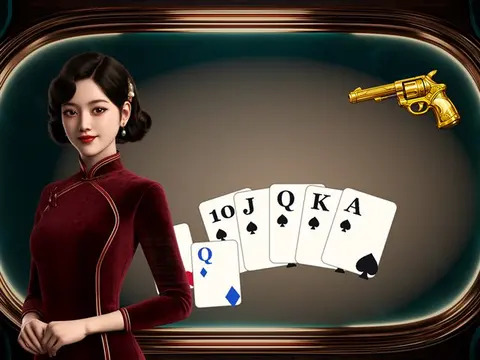
MacePlay's Thirteen is a four-player table set in a 1930s Shanghai jazz club, where the dealer calls “set your cards” and “showdown”. Rows are revealed one by one, and scoops and sweeps get their own effects. Tables start any time, with AI players filling empty seats.
MacePlay is for adults 18+ and for entertainment only. Virtual coins have no cash value and cannot be exchanged for cash or goods.
Ready? Open a table in MacePlay
Four-player Thirteen, with row-by-row reveals and effects for scoops and sweeps.